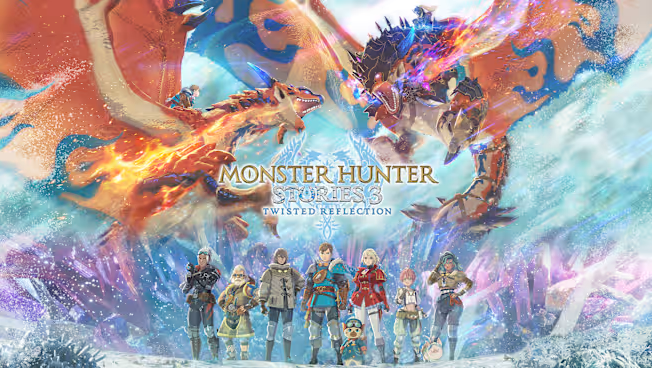
Monster Hunter Stories 3: Twisted Reflection released on March 13, 2026, and it deserves more attention than it’s getting. While everyone was watching Crimson Desert and Slay the Spire 2 dominate the Steam charts, Capcom quietly delivered one of the most polished JRPGs of the year so far — and Game Rant’s review makes the case that this is a series that has genuinely grown up.
What Happened: The JRPG Monster-Raising RPG Returns
Monster Hunter Stories 3: Twisted Reflection is not the mainline Monster Hunter you know. Forget the action-combat loop of Monster Hunter Wilds. Stories has always been a different beast entirely — a turn-based JRPG in the same universe, far closer to Pokémon in structure than to the hunting games that share its name.
The third entry in the series released on March 13, 2026, for PS5, Nintendo Switch 2, Xbox Series X|S, and PC. Game Rant’s reviewer had put 15+ hours into the demo alone before launch day — a testament to how deep the game’s systems go even before the full experience begins.
The core loop involves hunting monsters, harvesting their byproducts for gear, gathering eggs from monster lairs, and then naming, raising, and fighting alongside the creatures you collect. As a Ranger, you’re also tasked with a Habitat Restoration system: reintroducing endangered monster species to different regions, with population health graded from C to S. The more effort you put into restoring ecosystems, the better the monsters you encounter and collect.
Game Rant’s verdict is that Monster Hunter Stories 3 delivers “better, deeper gameplay systems befitting a JRPG giant,” with expanded combat mechanics and more exploration than any previous entry.

Industry Impact: Niche Games Win When They Nail Depth
Monster Hunter Stories 3 is a commercial niche product in a franchise that sells tens of millions of copies with its mainline titles. The Stories spin-offs have never competed on those numbers — but they do something the mainline games don’t: they tell stories, build characters, and reward patience and strategy over reflexes.
The JRPG space in 2026 is remarkably crowded. That Monster Hunter Stories 3 is holding its own in that context says something real about the quality of what Capcom has built. For the broader gaming industry, Stories 3 is an argument for thoughtful expansion of established IP — rather than diluting the Monster Hunter brand with a weak cash-in, Capcom invested in a genuinely separate experience with its own identity.
The Bigger Picture: Franchise Diversity as Smart Business
From an entrepreneurial lens, Monster Hunter Stories 3 is a smart move by Capcom. The company has long understood that its IP has multiple potential audiences — action fans, collectors, and story-driven RPG players — and Stories is the product line that serves the third group.
This kind of franchise diversification is increasingly important in gaming. The most durable IPs are the ones that can reach multiple demographics without diluting their core identity. Monster Hunter Stories 3 has that care in abundance — the Habitat Restoration system alone is a creative expansion that gives the game an ecological narrative layer unusual for the genre.
Conclusion
Monster Hunter Stories 3 is the JRPG of early 2026 that deserves to be talked about as much as Slay the Spire 2. It’s deep, it’s polished, and it takes real risks with its design. If you have even a passing interest in turn-based RPGs — and especially if you’re a lapsed Monster Hunter fan — this one is worth every hour.