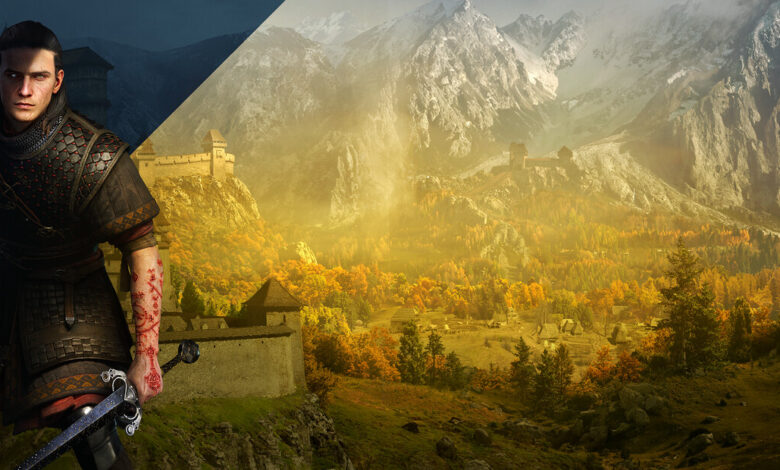
The Blood of Dawnwalker is the rare RPG that hands you a stopwatch instead of an open-ended map, and that single decision makes it one of the more interesting releases of the year. Built by Rebel Wolves, a studio stacked with veterans who spent years shaping The Witcher 3, this vampire-horror RPG swings for ideas most big-budget teams are too cautious to try. It mostly connects. But anyone who has followed these developers before will recognize the moment the studio pulls its punches, and that hesitation is exactly what keeps a genuinely original RPG from becoming an essential one.
A Curse With a Countdown: Why the Day-Night Split Actually Matters
Most vampire games treat the human-monster duality as flavor text. Dawnwalker treats it as the entire skeleton of the game. Protagonist Coen gets turned by a vampire named Brencis, but the transformation stalls halfway, leaving him a sword-carrying human by day and a supernatural predator by night. That alone isn’t new. What is new: his family sits captive ahead of a coronation happening in thirty in-game days, and every quest, side story, or detour spends a piece of that clock.
This turns exploration into a real gamble instead of a checklist. Chasing a side character’s backstory might cost you the chance to save someone else before their window closes. For business-minded players used to opportunity cost, it’s a familiar and satisfying tension: every choice has a price, and the game never lets you forget it. Few RPGs this size have the nerve to make time a spendable resource rather than a background clock, and it’s the single smartest swing Rebel Wolves takes.
Where Rebel Wolves Loses Its Nerve: Combat That Plays It Safe
The countdown mechanic promises a game that punishes hesitation everywhere, but combat doesn’t follow that same logic. Swordplay is functional rather than thrilling, closer to a stiffer version of recent medieval-combat RPGs than anything as fluid as its Witcher lineage might suggest. Enemy variety runs thin by the midgame, and boss fights lean on a small rotation of attack patterns that repeat more than they escalate.
That’s the frustrating part: the studio clearly knew how to build tension through scarcity and consequence in its quest design, yet combat encounters feel like they were built on a separate, more conventional brief. A game this confident about forcing hard choices elsewhere should have been equally bold about making every fight feel dangerous and distinct. Instead, combat becomes the one system that never quite catches up to the ambition surrounding it.

A Smaller World, a Smarter Game: Vale Sangora Done Right
Dawnwalker’s map, Vale Sangora, isn’t trying to be the biggest open world on shelves, and that restraint pays off. Because the region is compact enough to revisit repeatedly within the thirty-day pressure cooker, locations start to feel lived-in rather than like waypoints on a checklist. Side quests carry real narrative weight here, often rivaling the main story, and many can be approached multiple ways depending on who you’ve helped, who you’ve ignored, and how much time you’ve already burned.
The choice-and-consequence framework is where the game’s ambition and execution finally line up. Picking one questline over another isn’t just a flavor decision, it’s a resource allocation problem with a visible clock attached, which flips the usual open-world formula of “do everything eventually” on its head. This is the part of the game that most clearly justifies the studio’s pedigree, and it’s where newer developers chasing scale over intention should be taking notes.
The Verdict: An RPG Worth Playing for Its Ambition Alone
The Blood of Dawnwalker isn’t a flawless successor to the pedigree behind it, but it doesn’t need to be. It’s a horror RPG willing to make time itself the main character, and that idea alone makes it worth a purchase for genre fans who are tired of open worlds that never ask anything of them. The combat holds it back from greatness, but the writing, the countdown structure, and the tightly scoped world make this a genuinely original entry in a genre that rarely takes real risks. Rebel Wolves built something with teeth. It just needs a sharper bite next time.
Related on BizzNerd